NanopartzTM has developed a
brand new material – MicrogoldTM - the largest
monodisperse gold particles available. MicrogoldTM are hundreds of nanometers in the transverse
dimension and up to 1 micron in lengths. MicrogoldTM are the largest known "nanoparticles" available -
and the largest that can still be considered
nanoparticles. These particles match the
wavelength of light in the longitudinal dimension
providing single particle detection under white light
microscopy or dark field microscopy with simple
instrumentation. They have approximately 100 times
the scattering cross section as a 100 nm spherical gold
nanoparticle, 100,000 to 1,000,000 times the scattering
of a 1.4 nm gold nanoparticle. As with all of
NanopartzTM
products, they are
highly monodisperse.
Two sizes
are available, 150x800nm and 200x1000nm.
Features
Benefits
-
Perfect for
microscopy labeling without silver growth
-
Applications in tribological additives
-
Large
size enables use as labels in electron microscopy

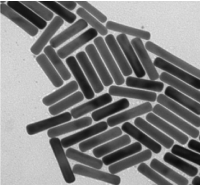
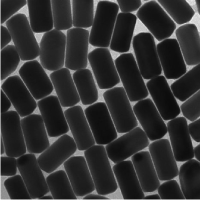
SEM of 150x800nm GMRs
Composition
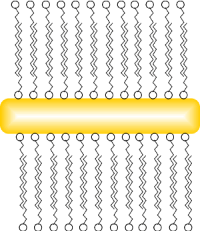
The bare
MicrogoldTM are shipped in DI water
with < 0.1% ascorbic acid and < 0.1% CTAB surfactant capping
agent. The conjugated
MicrogoldTM are shipped n DI water
at pH=7.0 and have the CTAB reduced to < 0.0001%.
Custom Formulation
The transverse size is 30
nm with two initial standard lengths of 150 and 1000 nm. All orders come with
a
Certificate of Analysis. Other sizes are special
order. Please contact us.
Products
For larger quantities, or
for orders amounting over 1 L per annum, please contact
sales for quantity pricing.
Delivery
All shipments are made Fed Ex Standard Overnight delivery.
No shipments on Fridays.
Conjugation
Unlike spherical gold nanoparticles where the
net surface charge is negative thereby affording passive
antibody adsorption,
MicrogoldTM have a net positive surface
charge. Consequently, it is strongly recommended that for
conjugating you purchase our custom conjugation services.
Conjugation Part Number Description
70-XXX-YYY are the bare
MicrogoldTM where XXX is the
transverse diameter (either 150 or 200 nm) and YYY are the
lengths (800 or 1000nm). 70-P(A,B,C,M,N)-XXXX are the conjugated
nanorods where A, B, C, M, and N stand for amine, biotin,
carboxyl, methyl and neutravidin, respectively, and YYY are
the lengths in (nm) (either 800 or 1000nm).
|
|
Specifications
|
In batch size variation |
< 10% CV length |
|
Shape monodispersity |
> 95% nanorods |
|
Axial sizes available |
30 nm |
|
|
|
|
Zeta charge |
|
|
Bare |
+40mV typ |
|
Methyl |
0 |
|
Carboxyl |
-20 |
|
Amine |
10 |
|
Biotin |
-5 |
|
Neutravidin |
-0.5 |
|
|
|
|
CTAB |
|
|
Bare |
<3.5% |
|
Conjugated |
<0.0001% |
|
Microgold Part # |
Axial Diameter (nm) |
Long Size (nm) |
NPS/mL |
Wt. conc
(mg/mL) |
Wt. % |
PPM |
Molarity (pM) |
|
70-150-800-20 |
150 |
800 |
1.80E+08 |
.05 |
0.01% |
50 |
0.3 |
|
70-200-1000-20 |
200 |
1000 |
8.30E+07 |
.05 |
0.01% |
50 |
0.1 |
|
70-P(A,B,C,M,N)-800-10 |
150 |
800 |
1.80E+08 |
.05 |
0.01% |
50 |
0.3 |
|
70-P(A,B,C,M,N)-1000-10 |
200 |
1000 |
8.30E+07 |
.05 |
0.01% |
50 |
0.1 |
| |
|
|
|
|
|
|
|
|
Shape monodispersity (% rods) > 95% |
|
|
|
|
|
Size variation +/-20% (both dimensions) |
|
|
|
|
|
All specs typical. May vary batch to batch. Exact
values are measured for each batch |
|
Product Number and Pricing To begin online shopping push on

|
Part # |
Description |
Price |
|
70-150-800-20 |
Microgold, 150x800 nm, 0.05mg/mL, 20 ml |
$490
|
|
70-200-1000-20 |
Microgold, 200x1000nm, 0.05mg/mL, 20 ml |
$490
|
|
70-P(A,B,C,M,N)-800-10 |
Conjugated Microgold,
150x800nm, 0.05mg/mL, 10mL |
$540
|
|
70-P(A,B,C,M,N)-1000-10 |
Conjugated Microgold,
200x1000nm, 0.05mg/mL, 10mL |
$540
|
|
|
Applications
Nanomaterials
Sensors
Light and Dark Field
Microscopy
Electron Microscopy
Labels
|

NanopartzTM
Microgold scatter 50 times greater than our 90nm spherical gold
particles, which in turn, scatter 100 times greater than our 10nm
spherical gold nanoparticles - you do the math. No more
silver growth for histology - See individual Microgold in white
light spectroscopy. Purchase them with custom
conjugations and charges for intercellular uptake.
|
|
|
 |
|