
Nanopartz Functionalized Gold Nanoparticles
Nanopartz Gold Nanoparticles, conjugated specifically for in vitro applications, utilize the complete line of Accurate Spherical Gold Nanoparticles, Gold Nanorods, Microgold, Gold Nanowires, and Plasmonic Fluorophores conjugated via a proprietary covalent polymer bridge to the most popular in vitro terminations including PEG, alkyne, amine, azide, biotin, carboxyl, hydroxyl, methyl, maleimide, neutravidin, nhs, streptavidin, GSH, Protein A and G, Galactose, Thiol, and secondary antibodies. This family of products is well known for its resistant to temperature, salt, and pH, and for its exceptional loading capability. These conjugated particles can be used in a multitude of applications, including diagnostics, imaging, particularly in adverse environments. These particles are guaranteed not to aggregate. Every batch is completely characterized including size, monodispersity, aggregation, residual chemicals, and concentration. Typical volume is 1mL at a concentration of 50 OD. A Certificate of Analysis (COA) is provided for every order exhibiting TEM and UV-VIS images and data, as well as DLS data. In all cases, the loading of the target is determined.
FREE - These products, like all of our products, are BSA Free, Sodium Azide Free, and Glycerol Free
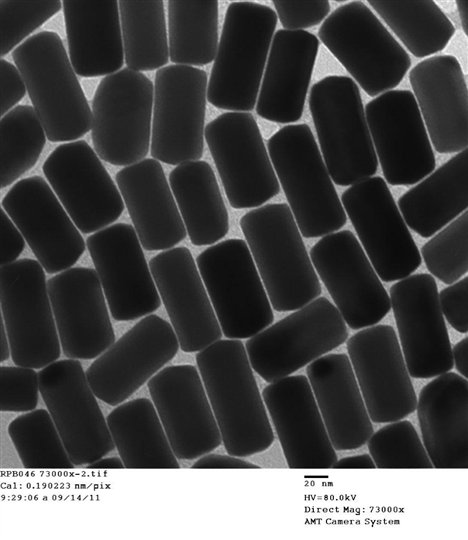
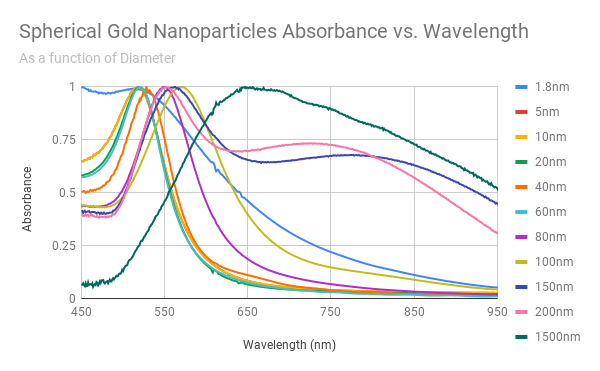
Part # |
Diameter (nm) |
Peak SPR Wavelength (nm) |
NPS/ml |
Molarity (pM) |
Moles |
Molar Ext. (M-1cm-1) |
Absorption Molar Ext. (M-1cm-1) |
Scattering Molar Ext. (M-1cm-1) |
Size Dispersity %PDI |
Size Accuracy (+/- nm) |
C11-1.8 |
1.8 |
n/a |
4.25E+16 |
7.10E+07 |
7.09E-08 |
7.05E+05 |
7.05E+05 |
0.00E+00 |
<35% |
0.1 |
C11-2.2 |
2.2 |
n/a |
2.33E+16 |
3.90E+07 |
3.88E-08 |
1.29E+06 |
1.29E+06 |
0.00E+00 |
<25% |
0.1 |
C11-3 |
3 |
n/a |
9.19E+15 |
1.50E+07 |
1.53E-08 |
3.26E+06 |
3.26E+06 |
0.00E+00 |
<20% |
0.1 |
C11-4 |
4 |
n/a |
3.88E+15 |
6.50E+06 |
6.46E-09 |
7.74E+06 |
7.74E+06 |
0.00E+00 |
<20% |
1 |
C11-5 |
5 |
512 |
1.99E+15 |
3.30E+06 |
3.31E-09 |
1.51E+07 |
1.51E+07 |
0.00E+00 |
<20% |
2 |
C11-10 |
10 |
516 |
2.48E+14 |
4.10E+05 |
4.14E-10 |
1.21E+08 |
1.21E+08 |
0.00E+00 |
<15% |
2 |
C11-15 |
15 |
518 |
7.35E+13 |
1.20E+05 |
1.23E-10 |
4.08E+08 |
4.08E+08 |
0.00E+00 |
<15% |
2 |
C11-20 |
20 |
520 |
3.10E+13 |
5.20E+04 |
5.17E-11 |
9.67E+08 |
9.67E+08 |
0.00E+00 |
<10% |
2 |
C11-25 |
25 |
521 |
1.59E+13 |
2.60E+04 |
2.65E-11 |
1.89E+09 |
1.89E+09 |
0.00E+00 |
<10% |
2 |
C11-30 |
30 |
523 |
9.19E+12 |
1.50E+04 |
1.53E-11 |
3.26E+09 |
3.26E+09 |
0.00E+00 |
<6% |
2 |
C11-35 |
35 |
526 |
5.79E+12 |
9.60E+03 |
9.65E-12 |
5.18E+09 |
5.18E+09 |
0.00E+00 |
<6% |
2 |
C11-40 |
40 |
527 |
3.88E+12 |
6.50E+03 |
6.46E-12 |
7.74E+09 |
7.72E+09 |
2.24E+07 |
<4% |
2 |
C11-45 |
45 |
529 |
2.72E+12 |
4.50E+03 |
4.54E-12 |
1.10E+10 |
1.08E+10 |
2.03E+08 |
<4% |
2 |
C11-50 |
50 |
531 |
1.99E+12 |
3.30E+03 |
3.31E-12 |
1.51E+10 |
1.45E+10 |
5.88E+08 |
<4% |
2 |
C11-55 |
55 |
533 |
1.49E+12 |
2.50E+03 |
2.49E-12 |
2.01E+10 |
1.88E+10 |
1.30E+09 |
<4% |
2 |
C11-60 |
60 |
536 |
1.15E+12 |
1.90E+03 |
1.91E-12 |
2.61E+10 |
2.36E+10 |
2.48E+09 |
<4% |
2 |
C11-65 |
65 |
539 |
9.04E+11 |
1.50E+03 |
1.51E-12 |
3.32E+10 |
2.89E+10 |
4.33E+09 |
<4% |
2 |
C11-70 |
70 |
542 |
7.23E+11 |
1.20E+03 |
1.21E-12 |
4.15E+10 |
3.44E+10 |
7.09E+09 |
<4% |
2 |
C11-75 |
75 |
545 |
5.88E+11 |
9.80E+02 |
9.80E-13 |
5.10E+10 |
4.00E+10 |
1.10E+10 |
<4% |
2 |
C11-80 |
80 |
549 |
4.85E+11 |
8.10E+02 |
8.08E-13 |
6.19E+10 |
4.54E+10 |
1.65E+10 |
<4% |
2 |
C11-85 |
85 |
553 |
4.04E+11 |
6.70E+02 |
6.73E-13 |
7.42E+10 |
5.03E+10 |
2.39E+10 |
<4% |
2 |
C11-90 |
90 |
558 |
3.40E+11 |
5.70E+02 |
5.67E-13 |
8.81E+10 |
5.44E+10 |
3.37E+10 |
<4% |
2 |
C11-95 |
95 |
563 |
2.89E+11 |
4.80E+02 |
4.82E-13 |
1.04E+11 |
5.72E+10 |
4.65E+10 |
<4% |
2 |
C11-100 |
100 |
569 |
2.48E+11 |
4.10E+02 |
4.14E-13 |
1.21E+11 |
5.82E+10 |
6.27E+10 |
<4% |
2 |
C11-150 |
150 |
612 |
7.35E+10 |
1.20E+02 |
1.23E-13 |
4.08E+11 |
0.00E+00 |
4.08E+11 |
<4% |
10 |
C11-200 |
200 |
n/a |
3.10E+10 |
5.20E+01 |
5.17E-14 |
9.67E+11 |
0.00E+00 |
9.67E+11 |
<4% |
10 |
C11-500 |
500 |
n/a |
1.99E+09 |
3.30E+00 |
3.31E-15 |
1.51E+13 |
0.00E+00 |
1.51E+13 |
<4% |
50 |
C11-1000 |
1000 |
n/a |
2.48E+08 |
4.10E-01 |
4.14E-16 |
1.21E+14 |
0.00E+00 |
1.21E+14 |
<4% |
100 |
C11-1500 |
1500 |
n/a |
7.35E+07 |
1.20E-01 |
1.23E-16 |
4.08E+14 |
0.00E+00 |
4.08E+14 |
<4% |
100 |
Optical Density >= 50, 5 for sizes >=500nm
|
Wt conc = 2.5mg/mL, 1mL volume typical
|
Wt % = 0.25%
|
| ppm = 2500 |
%PDI = Std Dev/Size
|
See Tech Note TN801 for definition of terms and method of analysis
|
All specs typical. May vary batch to batch. Exact values are measured for each batch
|
Shape monodispersity (% spheres) > 99.9%
|
Solution default is 18MEG DI water
|
Residual Chemicals < 0.1%
|
Part # |
Diameter (nm) |
Length (nm) |
Peak SPR Wave (nm) |
Aspect Ratio |
OD SPR (AU) |
Peak LSPR Wave (nm) |
OD LSPR (AU) |
Nanorods /mL |
Wt. conc (ug/ml) |
Wt. % |
PPM |
Molarity (nM) |
Picomoles |
SPR Molar Ext. (M-1cm-1) |
LSPR Molar Ext. (M-1cm-1) |
Peak SPR (nm) |
SPR Linewidth 80% (nm) |
C12-5-808 |
5 |
21 |
808 |
4.2 |
50 |
510 |
10 |
2.39E+14 |
1750 |
0.18% |
1750 |
398.72 |
3.99E+02 |
1.25E+08 |
2.51E+07 |
794-829 |
100 |
C12-5-780 |
5 |
19 |
780 |
3.8 |
50 |
510 |
10 |
2.67E+14 |
1750 |
0.18% |
1750 |
444.72 |
4.45E+02 |
1.12E+08 |
2.25E+07 |
765-794 |
100 |
C12-5-700 |
5 |
15 |
700 |
3 |
50 |
510 |
10 |
3.47E+14 |
1750 |
0.18% |
1750 |
578.14 |
5.78E+02 |
8.65E+07 |
1.73E+07 |
675-725 |
100 |
C12-10-2100 |
10 |
175 |
2100 |
17.5 |
50 |
510 |
10 |
6.73E+12 |
1750 |
0.18% |
1750 |
11.21 |
1.12E+01 |
4.46E+09 |
8.92E+08 |
1900-2300 |
300 |
C12-10-1400 |
10 |
102 |
1400 |
10.2 |
50 |
510 |
10 |
1.17E+13 |
1750 |
0.18% |
1750 |
19.47 |
1.95E+01 |
2.57E+09 |
5.14E+08 |
1300-1500 |
150 |
C12-10-1200 |
10 |
81 |
1200 |
8.1 |
50 |
510 |
10 |
1.48E+13 |
1750 |
0.18% |
1750 |
24.67 |
2.47E+01 |
2.03E+09 |
4.05E+08 |
1132-1300 |
150 |
C12-10-1064 |
10 |
67 |
1064 |
6.7 |
50 |
510 |
10 |
1.81E+13 |
1750 |
0.18% |
1750 |
30.13 |
3.01E+01 |
1.66E+09 |
3.32E+08 |
1022-1132 |
150 |
C12-10-980 |
10 |
59 |
980 |
5.9 |
50 |
510 |
10 |
2.09E+13 |
1750 |
0.18% |
1750 |
34.91 |
3.49E+01 |
1.43E+09 |
2.86E+08 |
965-1022 |
150 |
C12-10-950 |
10 |
55 |
950 |
5.5 |
50 |
510 |
10 |
2.22E+13 |
1750 |
0.18% |
1750 |
37 |
3.70E+01 |
1.35E+09 |
2.70E+08 |
925-965 |
150 |
C12-10-900 |
10 |
50 |
900 |
5 |
50 |
510 |
10 |
2.47E+13 |
1750 |
0.18% |
1750 |
41.11 |
4.11E+01 |
1.22E+09 |
2.43E+08 |
875-925 |
150 |
C12-10-850 |
10 |
45 |
850 |
4.5 |
50 |
510 |
10 |
2.78E+13 |
1750 |
0.18% |
1750 |
46.25 |
4.63E+01 |
1.08E+09 |
2.16E+08 |
829-875 |
100 |
C12-10-808 |
10 |
41 |
808 |
4.1 |
50 |
510 |
10 |
3.10E+13 |
1750 |
0.18% |
1750 |
51.68 |
5.17E+01 |
9.68E+08 |
1.94E+08 |
794-829 |
75 |
C12-10-780 |
10 |
38 |
780 |
3.8 |
50 |
510 |
10 |
3.36E+13 |
1750 |
0.18% |
1750 |
56.06 |
5.61E+01 |
8.92E+08 |
1.78E+08 |
765-794 |
65 |
C12-10-750 |
10 |
35 |
750 |
3.5 |
50 |
510 |
10 |
3.70E+13 |
1750 |
0.18% |
1750 |
61.67 |
6.17E+01 |
8.11E+08 |
1.62E+08 |
725-765 |
50 |
C12-10-700 |
10 |
29 |
700 |
2.9 |
50 |
510 |
10 |
4.44E+13 |
1750 |
0.18% |
1750 |
74 |
7.40E+01 |
6.76E+08 |
1.35E+08 |
675-725 |
40 |
C12-10-650 |
10 |
24 |
650 |
2.4 |
50 |
510 |
10 |
5.55E+13 |
1750 |
0.18% |
1750 |
92.5 |
9.25E+01 |
5.41E+08 |
1.08E+08 |
625-675 |
40 |
C12-10-600 |
10 |
19 |
600 |
1.9 |
50 |
510 |
10 |
7.40E+13 |
1750 |
0.18% |
1750 |
123.34 |
1.23E+02 |
4.05E+08 |
8.11E+07 |
575-625 |
40 |
C12-25-1400 |
25 |
245 |
1400 |
9.8 |
50 |
514 |
15 |
1.12E+12 |
2500 |
0.25% |
2500 |
1.86 |
1.86E+00 |
2.69E+10 |
8.06E+09 |
1232-1500 |
150 |
C12-25-1064 |
25 |
137 |
1064 |
5.5 |
50 |
514 |
15 |
2.05E+12 |
2500 |
0.25% |
2500 |
3.42 |
3.42E+00 |
1.46E+10 |
4.38E+09 |
1022-1232 |
150 |
C12-25-980 |
25 |
119 |
980 |
4.8 |
50 |
514 |
15 |
2.39E+12 |
2500 |
0.25% |
2500 |
3.98 |
3.98E+00 |
1.26E+10 |
3.77E+09 |
965-1022 |
150 |
C12-25-950 |
25 |
102 |
950 |
4.1 |
50 |
514 |
15 |
2.82E+12 |
2500 |
0.25% |
2500 |
4.7 |
4.70E+00 |
1.06E+10 |
3.19E+09 |
925-965 |
150 |
C12-25-900 |
25 |
96 |
900 |
3.8 |
50 |
514 |
15 |
3.01E+12 |
2500 |
0.25% |
2500 |
5.02 |
5.02E+00 |
9.95E+09 |
2.99E+09 |
875-925 |
150 |
C12-25-850 |
25 |
93 |
850 |
3.7 |
50 |
514 |
15 |
3.12E+12 |
2500 |
0.25% |
2500 |
5.2 |
5.20E+00 |
9.61E+09 |
2.88E+09 |
829-875 |
150 |
C12-25-808 |
25 |
90 |
808 |
3.6 |
50 |
514 |
15 |
3.24E+12 |
2500 |
0.25% |
2500 |
5.39 |
5.39E+00 |
9.27E+09 |
2.78E+09 |
794-829 |
150 |
C12-25-780 |
25 |
87 |
780 |
3.5 |
50 |
514 |
15 |
3.36E+12 |
2500 |
0.25% |
2500 |
5.6 |
5.60E+00 |
8.93E+09 |
2.68E+09 |
765-794 |
150 |
C12-25-750 |
25 |
85 |
750 |
3.4 |
50 |
514 |
15 |
3.45E+12 |
2500 |
0.25% |
2500 |
5.75 |
5.75E+00 |
8.70E+09 |
2.61E+09 |
725-765 |
65 |
C12-25-700 |
25 |
75 |
700 |
3 |
50 |
514 |
15 |
3.96E+12 |
2500 |
0.25% |
2500 |
6.61 |
6.61E+00 |
7.57E+09 |
2.27E+09 |
675-725 |
60 |
C12-25-650 |
25 |
71 |
650 |
2.8 |
50 |
514 |
15 |
4.22E+12 |
2500 |
0.25% |
2500 |
7.03 |
7.03E+00 |
7.11E+09 |
2.13E+09 |
625-675 |
60 |
C12-25-600 |
25 |
57 |
600 |
2.3 |
50 |
514 |
15 |
5.43E+12 |
2500 |
0.25% |
2500 |
9.05 |
9.05E+00 |
5.52E+09 |
1.66E+09 |
575-625 |
60 |
C12-25-550 |
25 |
34 |
550 |
1.4 |
50 |
514 |
15 |
1.01E+13 |
2500 |
0.25% |
2500 |
16.91 |
1.69E+01 |
2.96E+09 |
8.87E+08 |
525-575 |
60 |
C12-40-1064 |
40 |
208 |
1064 |
5.2 |
50 |
520 |
20 |
5.30E+11 |
2500 |
0.25% |
2500 |
0.88 |
8.84E-01 |
5.66E+10 |
2.26E+10 |
1022-1232 |
150 |
C12-40-980 |
40 |
180 |
980 |
4.5 |
50 |
520 |
20 |
6.19E+11 |
2500 |
0.25% |
2500 |
1.03 |
1.03E+00 |
4.84E+10 |
1.94E+10 |
875-1022 |
150 |
C12-40-850 |
40 |
148 |
850 |
3.7 |
50 |
520 |
20 |
7.67E+11 |
2500 |
0.25% |
2500 |
1.28 |
1.28E+00 |
3.91E+10 |
1.57E+10 |
829-875 |
150 |
C12-40-808 |
40 |
134 |
808 |
3.4 |
50 |
520 |
20 |
8.56E+11 |
2500 |
0.25% |
2500 |
1.43 |
1.43E+00 |
3.51E+10 |
1.40E+10 |
794-829 |
150 |
C12-40-780 |
40 |
124 |
780 |
3.1 |
50 |
520 |
20 |
9.33E+11 |
2500 |
0.25% |
2500 |
1.55 |
1.55E+00 |
3.22E+10 |
1.29E+10 |
765-794 |
150 |
C12-40-750 |
40 |
112 |
750 |
2.8 |
50 |
520 |
20 |
1.05E+12 |
2500 |
0.25% |
2500 |
1.74 |
1.74E+00 |
2.87E+10 |
1.15E+10 |
725-765 |
150 |
C12-40-700 |
40 |
92 |
700 |
2.3 |
50 |
520 |
20 |
1.31E+12 |
2500 |
0.25% |
2500 |
2.19 |
2.19E+00 |
2.29E+10 |
9.14E+09 |
675-725 |
60 |
C12-40-650 |
40 |
80 |
650 |
2 |
50 |
520 |
20 |
1.55E+12 |
2500 |
0.25% |
2500 |
2.58 |
2.58E+00 |
1.94E+10 |
7.75E+09 |
625-675 |
60 |
C12-40-600 |
40 |
68 |
600 |
1.7 |
50 |
520 |
20 |
1.89E+12 |
2500 |
0.25% |
2500 |
3.15 |
3.15E+00 |
1.59E+10 |
6.35E+09 |
575-625 |
60 |
C12-40-550 |
40 |
60 |
550 |
1.5 |
50 |
520 |
20 |
2.21E+12 |
2500 |
0.25% |
2500 |
3.69 |
3.69E+00 |
1.36E+10 |
5.42E+09 |
525-575 |
60 |
C12-50-1064 |
50 |
245 |
1064 |
4.9 |
50 |
530 |
25 |
2.89E+11 |
2500 |
0.25% |
2500 |
0.48 |
4.82E-01 |
1.04E+11 |
5.18E+10 |
980-1232 |
150 |
C12-50-808 |
50 |
145 |
808 |
2.9 |
50 |
530 |
25 |
5.15E+11 |
2500 |
0.25% |
2500 |
0.86 |
8.58E-01 |
5.83E+10 |
2.91E+10 |
750-850 |
150 |
C12-50-700 |
50 |
110 |
700 |
2.2 |
50 |
530 |
25 |
7.08E+11 |
2500 |
0.25% |
2500 |
1.18 |
1.18E+00 |
4.24E+10 |
2.12E+10 |
650-750 |
150 |
C12-50-600 |
50 |
100 |
600 |
2 |
50 |
530 |
25 |
7.93E+11 |
2500 |
0.25% |
2500 |
1.32 |
1.32E+00 |
3.78E+10 |
1.89E+10 |
550-650 |
150 |
C12-70-750 |
70 |
120 |
750 |
1.7 |
50 |
530 |
25 |
3.49E+11 |
2500 |
0.25% |
2500 |
0.58 |
5.81E-01 |
8.60E+10 |
4.30E+10 |
700-800 |
150 |
C12-70-650 |
70 |
105 |
650 |
1.5 |
50 |
530 |
25 |
4.13E+11 |
2500 |
0.25% |
2500 |
0.69 |
6.88E-01 |
7.27E+10 |
3.63E+10 |
600-700 |
150 |
C12-70-550 |
70 |
91 |
550 |
1.3 |
50 |
530 |
25 |
4.98E+11 |
2500 |
0.25% |
2500 |
0.83 |
8.30E-01 |
6.02E+10 |
3.01E+10 |
500-600 |
150 |
Optical Density >= 50, volume = 1mL
|
All specs typical. May vary batch to batch. Exact values are measured for each batch
|
Solution default is 18MEG DI water
|
Residual Chemicals < 0.1%
|
Part # |
Diameter (nm) |
Length (nm) |
Aspect Ratio |
Peak SPR Wave (nm) |
SPR OD (1cm) |
Microgold /mL |
moles |
Wt. conc (ug/ml) |
Wt. % |
PPM |
Molarity (pM) |
SPR Molar Ext. (M-1cm-1) |
C13-500 |
75 |
500 |
6.7 |
510 |
0.25 |
6.18E+09 |
1.03E-14 |
250 |
0.03% |
250 |
10.3 |
2.43E+07 |
C13-1000 |
100 |
1000 |
10 |
510 |
0.25 |
1.71E+09 |
2.85E-15 |
250 |
0.03% |
250 |
2.85 |
8.78E+07 |
SPR = Transverse SPR peak
|
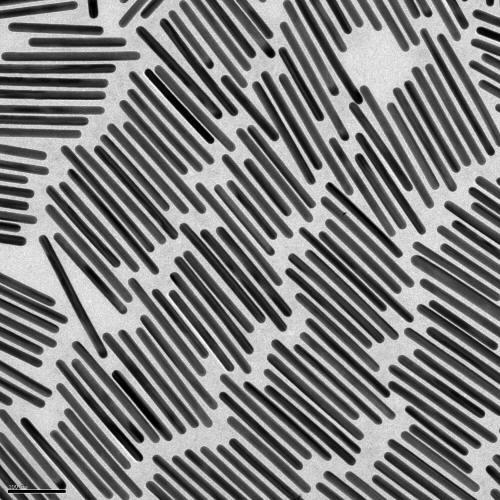
Longitudinal has no SPR peak
|
Shape monodispersity (% rods) > 95%
|
Size variation +/-10% (both dimensions)
|
Part # |
Diameter (nm) |
Length (nm) |
Aspect Ratio |
Peak SPR Wave (nm) |
Nanowires Vol (nm3) |
Nanowires /mL |
Wt. conc (ug/ml) |
Wt. % |
PPM |
Molarity (pM) |
SPR Molar Ext. (M-1cm-1) |
C14-1000 |
75 |
1000 |
13 |
510 |
4.31E+06 |
3.01E+09 |
250 |
0.03% |
250 |
5.02 |
9.96E+06 |
C14-2000 |
75 |
2000 |
27 |
510 |
8.72E+06 |
1.49E+09 |
250 |
0.03% |
250 |
2.48 |
2.02E+07 |
C14-4000 |
75 |
4000 |
53 |
510 |
1.76E+07 |
7.39E+08 |
250 |
0.03% |
250 |
1.23 |
4.06E+07 |
C14-6000 |
75 |
6000 |
80 |
510 |
2.64E+07 |
4.91E+08 |
250 |
0.03% |
250 |
0.82 |
6.10E+07 |
C14-10000 |
75 |
10000 |
133 |
510 |
4.40E+07 |
2.94E+08 |
250 |
0.03% |
250 |
0.49 |
1.02E+08 |
C14-20000 |
100 |
20000 |
200 |
510 |
1.57E+08 |
8.27E+07 |
250 |
0.03% |
250 |
0.14 |
3.63E+08 |
C14-40000 |
140 |
40000 |
286 |
510 |
6.15E+08 |
2.11E+07 |
250 |
0.03% |
250 |
0.04 |
1.42E+09 |
SPR = Transverse SPR peak
|
Longitudinal has no SPR peak
|
Shape monodispersity (% rods) > 95%
|
Size variation +/-10% (both dimensions)
|

Functionalized gold nanoparticle with Nanopartz™ covalently bonded polymer
Loading Range (nm2)
|
Charge (mV) | |||
| Smaller particles | Larger particles | Smaller particles | Larger particles | |
PEG |
3 |
1 |
-27 |
-12 |
Alkyne |
4 |
2 |
-25 |
-25 |
Amine |
4 |
2 |
-20 |
20 |
Azide |
4 |
2 |
-25 |
-25 |
Biotin |
3 |
1.5 |
-25 |
-15 |
Carboxyl |
4 |
2 |
-38 |
-45 |
Methyl |
4 |
2 |
-27 |
-12 |
Streptavidin |
0.01 |
0.01 |
-25 |
-10 |
Neutravidin |
0.01 |
0.01 |
-25 |
-10 |
GSH (Glutathione) |
3 |
1.5 |
-25 |
-15 |
Protein A |
0.04 |
0.04 |
-25 |
-10 |
Protein G |
0.04 |
0.04 |
-25 |
-10 |
Maleimide |
4 |
2 |
-27 |
-12 |
NHS |
3 |
1.5 |
-25 |
-15 |
Hydroxyl |
4 |
2 |
-27 |
-12 |
Thiol |
5 |
5 |
-30 |
-30 |
Galactose |
2 |
2 |
-30 |
-30 |
Mutab |
5 |
5 |
30 |
40 |
Secondary IgG |
0.02 |
0.02 |
0.02 |
0.02 |
Composition
These nanoparticles are shipped in 18MEG DI water (default solution) with no measurable residual reactants.
Custom Formulation
Please contact us.
Quantity
This product is available in 1mL volumes and larger.
Introductory Kits
Please contact us.
Delivery
Standard sizes are in stock. Special order sizes are shipped in two weeks or less. All domestic shipments are sent Fed Ex Standard Overnight delivery, international Fed Ex Priority 2 day. No shipments on Fridays except for dried particles. Saturday shipping available for extra charge.
Functionalization
This product comes with a number of different covalent options.
Shelf Life/Storage Temperature
This product is guaranteed for six months and should be stored at 4 °C after opening. Care must be taken to only use sterile glassware when working with this product.
Toxicity
This product is known to be noncytotoxic. This product has been sterilized and is biological free.
Sterilization
This product is sterilized.
For post sterilization testing, please choose Sterilization Certification.
For endotoxin purification, choose Endotoxin Purified.
Certifications
Every order comes with a Certification of Analysis that includes the following information. We use calibration traceable:
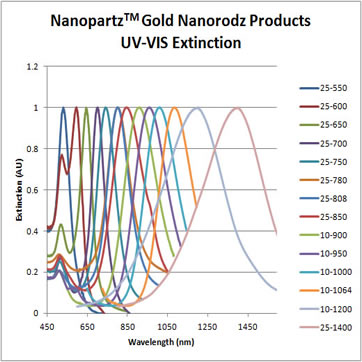
UV-VIS (Agilent 8453) for extinction and concentration measurements
NIR (Cary 500) for NIR extinction and concentration measurements
DLS (Malvern Nano ZS) for zeta potential measurement
ICP-MS (Varian 820-MS) for gold mass measurements
TEM (Phillips CM-100 100KV) for sizing
How much thickness does your proprietary capping agent add?
Anywhere from 1-5nm.
How do I determine the concentration of the product?
Simply divide the number of nanoparticles (nps) found on the included COA by the amount of solution you add.
Why do you sell your rods as OD-mLs and what does this mean?
This is because unlike spherical gold nanoparticles, the conversion from OD to mg is not linear with nanorod diameter. Consequently, for the same OD, the weight of the nanorods increases with diameter. 50 OD-mLs means that if you resuspend the material in 1mL of solvent, you will have an absorption of OD50 through a 1mL optical path.
Can I resuspend in water?
Yes
Can I suspend in silicon oil?
No
What is the shelf life if I never open the package and keep refrigerated?
Many years.
Should I store in the refrigerator?
Yes.
How do you size your gold nanoparticles? Does the size include the capping agent?
We use three methods to specify our gold nanoparticles; TEM, UV VIS, and DLS. Each has its own advantages and disadvantages, and we use a weighted system to take advantage of each methods strengths. In the end, we place the strongest weight to the TEM method, particularly since we use samples sizes greater than 50 particles for each lot.
Do you really provide a TEM for my specific lot?
Yes, and not just for 5-10 particles, rather 50-100 are standard.
Why are your small gold nanoparticles colored? I have seen 2nm particles on other website that look as clear as water.
All gold nanoparticles absorb and/or scatter. If you can't see them, then they probably aren't there.
What is OD?
Optical Density (OD) is measured by UV-VIS. An Optical Density OD=1 corresponds to a transmission of 10% through a 1cm cuvette. Optical Density is a nice unit to use since Optical Densities correlate linearly to concentration. So an Optical Density of 1.2 is equal to 1.2 times the concentration of a gold nanoparticle solution that has an Optical Density of 1. We use OD and concentration interchangingly as it is easier to refer to a solution of OD=1 rather than 2.35e12 nanoparticles. For all spheres up to 200nm, OD=1 does refer to 0.05mg/mL.
What is PDI?
PDI refers to polydispersity index and is equal to the standard deviation of the particle sizes divided by the average size.
How does your polymer bridge compare to PEG?
It is superior in its resistance to salt, pH, and other chemicals.
"We have looked at many different gold nanoparticles samples from Nanopartz including spheres, rods, and microrods using single particle spectroscopy techniques and are extremely happy with the quality of the samples and the service provided by Nanopartz."
Stephan Link, PhD
Assistant Professor of Chemistry
Rice University
Enhancing sensitivity of surface plasmon resonance biosensors by functionalized gold nanoparticles: size matters
covalently functionalized with neutravidin via a 2 nm polymer bridge were
purchased from Nanopartz Inc., USA. The diameters of the gold ...
Physisorption of functionalized gold nanoparticles on AlGaN/GaN high electron mobility transistors for sensing applications
functionalized with alkanethiols ... linkers to the gate area of AlGaN/GaN HEMTs include patterning
gold at the ... Also, the effectiveness of the UV functionalization method is offset by the limited ...
[HTML] Enhanced intracellular translocation and biodistribution of gold nanoparticles functionalized with a cell-penetrating peptide (VG-21) from vesicular stomatitis …
fluorescence microscopy, FITC conjugated VG-21 peptide was used for functionalization. ... GNPs
functionalized with FITC-conjugated VG-21 were used to study internalization of the ...
Wide‐field hyperspectral 3D imaging of functionalized gold nanoparticles targeting cancer cells by reflected light microscopy
of experimental spectral curves for single 100 nm functionalized AuNPs are presented in ... shifted
for about 6 nm that could be explained by AuNPs functionalization and attachment to ...
Size dependence of Au NP-enhanced surface plasmon resonance based on differential phase measurement
Accurate. ... The system was left for a period of 20 min and then rinsed by DI water to confirm the
functionalization. ... A review on functionalized gold nanoparticles for biosensing applications. ...
Mechanistic heteroaggregation of gold nanoparticles in a wide range of solution chemistry
nanospheres (AuNSs) in ... with 10 nm primary particle diameter were procured from Nanopartz
Inc. ... PA-SWNT Preparation To perform surface functionalization with pluronic acid (PA) F127 ...
Biofunctionalized gold nanoparticles for SPR-biosensor-based detection of CEA in blood plasma
USA, at ... During the functionalization processes described above, the flow rate and the temperature
were set ... BSA was flowed along the surface of an SPR chip functionalized with Ab1 ...
Multiplexed colorimetric detection of Kaposi's sarcoma associated herpesvirus and Bartonella DNA using gold and silver nanoparticles
of 15 and 20 nm, respectively, were functionalized using thiol based chemistry using methods
described by others. ... Gold nanoparticles were purchased from Nanopartz (Loveland, CO ...
[HTML] Plasmonic enhancement of dye sensitized solar cells via a tailored size-distribution of chemically functionalized gold nanoparticles
wt 1.75 ... nm), with optically dispersing TiO 2 particles (Ø ∼190 nm) and functionalized with AuNPs ...
TiO 2 functionalisation with AuNPs) and Figure 4 (after the functionalization) it can ...
The manufacturing method for these nanoparticles are based on our proprietary method. This family of products have resulted in more than 100 publications and is the cornerstone of our product line. Other covalent polymer bridges are available as well. Please follow the menu to find options from 1 carbon to 30KDa length covalent polymer bridges.
| Nanopartz™ in vitro Gold Nanoparticles | PEG Gold Nanoparticles | |
| Stability (salt,pH,chemicals) | High | Medium |
| Monovalent | Yes | No |
| Nonspecific binding | Very low | Medium |
| Sterilization | Yes | No |
- Covalent bonds insure specificity, stability, long shelf life
- Buffer Stability - stable from pH 4-9
- No sodium azide
- No BSA
- Polymer coating insures no aggregation in high salts, reduced nonspecific binding
- Stable
- Well Characterized
- Customer can select buffer
- Customer can select gold nanoparticle type, size and/or SPR
- Loading of all ligands is optimized
Example part number is C11-10-TAZ-DIH-50-1-CS-EP where:
C11 - Product family number for In Vitro Spherical Gold Nanoparticles. For Gold Nanorods, its C12 and so forth.
10 - Sphere diameter in nanometers. Other choices are 1.8 to 1500
TAZ - Covalent ligand, in this case Azide.
DIH - Buffer, in this case 18MEG DI water. Other choices are PBS, MES, Sodium Borate, TRIS
50 - Optical Density, in this case OD=50, optional 250
1 - Volume (mL). Other choices are 5mL, 10mL and more.
CS - Certified Sterilized - Though the product come sterilized, this option includes testing and certification.
EP - Endotoxin Purified - The product is endotoxin purified and certified.
Ordering by scrolling down and selecting the options from the selection below.